Monday, August 1, 2011

Mini Reviews (or Many Reviews)

Yikes! I haven't updated this blog in months. Time to play catch up.

"Submarine"
Touching "coming of age" story that wows with both its wicked sense of humor and unexpected emotional resonance.

"Super 8"
Entertaining throwback to the Spielbergian blockbuster. Sentimental in all the right ways. Although one wishes the filmmakers would have chose not to visualize some of the film's more mysterious plot points.


"Midnight in Paris"
Clips by at a light, breezy pace without saying anything all that insightful. Underwhelming.

"Harry Potter and the Deathly Hallows: Part 2"
Powerful finale to the "Potter" film series. Wrings emotion out of its epic battle scenes, while also allowing time for some more intimate moments. Stunning visual effects that make for great visual spectacle, while also serving the emotion of the story. Stellar acting from Fiennes, Radcliffe, and Rickman.


"Beginners"
Touching portrayal of a father-son relationship. Handles each of its characters with great warmth and subtlety. Thankfully ditches most of its "indie" cliches by film's second act. Impressive performance from Ewan McGregor.


"Crazy Stupid Love"
Starts off as a bland, but serviceable, romantic comedy, but quickly succumbs to many of the genre's worst cliches. Overstays its welcome by nearly twenty minutes. The film's impressive ensemble somehow manage to stay afloat. Lacks emotional honesty and genuine wit. Should be re-titled "Stupid Stupid Stupid."

"Source Code"
An entertaining, thought-provoking thriller with solid acting, but an unfortunately weak ending. Film's final reveal left this reviewer feeling cheated.

Friday, June 10, 2011

The Tree of Life


EPIC.

Grace. Nature. Perseverance. Beauty. Grief. Light. Darkness. Dinosaurs.

In other words, I'm not even going to attempt to fully analyze this film until I catch it a second time. That being said, it is well worth your time and your money.

Wednesday, June 1, 2011

"Bridesmaids" Review


"Bridesmaids," which follows Kristen Wiig as down-on-her-luck Annie, as she prepares for the wedding of her best friend Lillian (Maya Rudolph), beautifully mixes physical comedy, witty dialogue and genuine poignancy without feeling forced or unfocused. It is the rare "human" comedy that elicits laughter, while also conveying some greater meaning about human relationships.

The film, written by Wiig and co-screenwriter Annie Mumollo, focuses primarily on the rivalry between Wiig's Annie and Rose Byrne's Helen, one of the other bridesmaids who Annie perceives as a threat to her friendship with Lillian. Adding to the film's humor are the other three bridesmaids: the sugary sweet Becca (Ellie Kemper), the disillusioned mother Rita (Wendi McLendon-Covey), and the butch, eccentric Megan (Melissa McCarthy). This ensemble of strong female comedians are at the top of their game with each one nailing their respective punchlines.

Wiig, in particular, makes quite an impression. She not only shows off both her expert comic timing, but also display sher dramatic acting chops. This versatility allows Wiig to shift effortlessly between comedy and drama, as she create a vivid characterization of a woman who has not only lost the will to fight for herself, but has also lost sight of her own value, both as a friend and as a woman. While Annie cannot provide for Lillian in the same way Helen does, that does not make her any less of a friend - a truth that Annie finally accepts by the film's third act. Annie also realizes her worth in regards to her relationships. Instead of letting the smarmy Ted (Jon Hamm) use her, she chooses a man (Chris O'Dowd) that respects and values her.

It is this attention to emotional detail that makes "Bridesmaids" such a breath of fresh air. Instead of simply stringing together a collection of crass jokes, Wiig and director Paul Feig effortlessly marry gut-busting laughter with emotional poignancy to create what is easily the best comedy of the year thus far.

Friday, May 20, 2011

One-Liners


Dearest Readers,

I am sorry for my lengthy hiatus. I have been busy with school, theater, and other madness, but I should be back for good, now that summer has arrived. I promise to write a full review soon, but, for now, I will leave you with a few pithy one-line reviews of some recent films.

"Hanna"
A loopy genre pic with some fun action sequences. Lacks depth.

"The Conspirator"
Interesting historical thriller featuring a stand-out performance from Robin Wright. Last act fails to pack the expected emotional punch.

"Thor"
Average superhero pic marred by weak dialogue and tonal inconsistencies. Poor Natalie Portman.

"Meek's Cutoff".
A slow-moving, atmospheric western with a feminist twist. Expert pacing. Great performances all around. But perhaps a little dry.

Sunday, March 27, 2011

Paul Eyre


"Paul" (d. Greg Motolla)
  • Story follows two sci-fi geeks (Simon Pegg and Nick Frost), as they make a road trip across America only to find themselves greeted by a talking, fugitive alien (Seth Rogen).
  • Gets off to a slow start with much of its humor revolving around pop culture references that only hardcore geeks will pick up on.
  • Hilarious ensemble of great character actors, but the script rarely gives them anything to work with. While Bill Hader and Joe Lo Truglio milk laughs as two bumbling FBI agents, the usually hysterical Kristen Wiig just seems miscast as a fundamentalist Christian who falls for Simon Pegg's character. Other great character actors, like Jason Bateman and Sigourney Weaver, are wasted in smaller roles.
  • The film musters up some momentum in its second act by amplifying its more zany qualities, only to lose that momentum once the film reaches its sappy, overlong resolution.
  • While the film remains superior to most of the bland, commercial comedies that populate the multiplexes, it's disappointing that the final product was not more entertaining, especially considering the talent involved.
"Jane Eyre" (d. Cary Fukunaga)
  • Impressively atmospheric adaption of the 19th century coming-of-age story by Charlotte Bronte.
  • The film follows young orphan Jane Eyre (Mia Wasikowska) as she moves from a strict boarding school to the mansion of Edward Rochester (Michael Fassbender).
  • Brilliantly illustrates Jane Eyre's struggle between independence and companionship as she confronts her affection for Mr. Rochester, as well as her want to break free from the bonds which society places her in, due to both her circumstances and her gender. Wasikowska subtly taps into Jane's psyche as she struggles with these two desires. Fassbender also shines as a man yearning for a deeper relationship, whilst also feeling trapped due to his circumstances.
  • The film's dark cinematography wonderfully accentuates the film's mood and makes the audience more keenly aware of the feelings of confinement which plague the film's characters.
  • Deliberately slow pace adds to the film's atmosphere, but perhaps makes the film harder to connect to on an emotional level. Still, a faster pace would have killed the chilling, almost eerie, mood which makes the film so unique.
  • Overall, a fascinating, hauting coming-of-age story with top-notch performances and production values.

Saturday, March 19, 2011

"Digimon: The Movie" Review


"Digimon: The Movie," based off the landmark Japanese television series of the same name, quite brilliantly explores the ideas of community and friendship. While the hoi polloi prefer such trash like "Pokemon: The First Movie" and "Pokemon: Mewtwo Returns," neither film holds a candle to the level of quirk and irony found in "Digimon: The Movie."

The film is split into three marvelous acts. The first act follows Tai and Kari, two young Japanese hipsters, as they come across a Digimon, a digital creature with the power to evolve into larger digital creature. After this discovery, the film flashes forward 4 years later and it's almost like you're watching a completely different movie! At this point, the story follows Tai and the gang as an evil mutant Digimon takes over the internet. And just when you think the film's going to end, it flashes forward to the present day with completely different characters trying to defeat the evil Kokomon once and for all. While some totally lame people would find this three act structure disjointed and off-putting, it added to this reviewer's ironic enjoyment of the film.

And let's not forget the stellar soundtrack! With such classic jams like "All Star"by Smash Mouth and "One Week" by the Barenaked Ladies, the film's soundtrack's only adds to the film's hipness. While lesser people may find the songs catchy and enjoyable, they won't pick up on the satiric irony inherent to their placement in the film. In fact, the unwashed masses might enjoy the film as a whole, but they will never have the intellectual prowess to decipher the film's weighty subtext.

But, at its heart, "Digimon: The Movie" truly examines what it's like to be human. It asks us many important questions. Who does one turn to in times of great need? Can community help us overcome great obstacles? And, perhaps most importantly, is this film obscure enough to add to my DVD collection?

[This review is dedicated to Seamus Hamilton, King of the Hipsters]

Friday, March 11, 2011

"Rango" Review


Overflowing with verbal humor and visual wackiness, "Rango," a new animated film from director Gore Verbinski ("Pirate of the Caribbean"), snaps along at a quick pace with its off-the-wall humor, frenzied action sequences, and emotional warmth. The film follows Rango - a lonely domestic lizard - as he ventures into the desert to live amongst other desert animals. In order to fit in with his fellow animals, Rango (voiced by Johnny Depp) pretends to be a tough-as-nails gunslinger. While Rango's ruse proves amusing for him at first, the animals naively buy in to his tall tale and elect him town sheriff. As Rango takes on his sheriff duties, which include solving the town's water shortage and chasing off a mean hawk, he slowly breaks free from his isolation and finds purpose in serving a warm, appreciative community of fellow desert animals. "Rango" very eloquently illustrates this idea of community, without resorting to sappy dialogue or overwrought sentimentality. Instead, the film creates a rag tag group of zany characters that win the audience's affection and lend the film a stronger emotional connection. However, what truly makes the film original is its loony sense of humor. From witty wordplay to hysterical sight gags, "Rango" displays nearly impeccable comic timing. In short, it makes for one heck of a good time at the movies. (And, yes, I did just end this short review with a cliche).

Saturday, February 26, 2011

Academy Award Predictions


Best Picture: "The King's Speech"
Best Director: David Fincher - "The Social Network"
Best Actor: Colin Firth - "The King's Speech"
Best Actress: Natalie Portman - "Black Swan"
Best Supporting Actor: Christian Bale - "The Fighter"
Best Supporting Actress: Melissa Leo - "The Fighter"
Best Original Screenplay: "The King's Speech"
Best Adapted Screenplay: "The Social Network"
Best Art Direction: "Inception"
Best Cinematography: "True Grit"
Best Costume Design: "The King's Speech"
Best Film Editing: "The Social Network"
Best Makeup: "The Wolfman"
Best Original Score: "The Social Network"
Best Song: "Toy Story 3"
Best Sound Editing: "Inception"
Best Sound Mixing: "Inception"
Best Visual Effects: "Inception"
Best Animated Film: "Toy Story 3"
Best Foreign Language Film: "In A Better World"
Best Documentary: "Inside Job"
Best Documentary Short Subject: "Sun Come Up"
Best Animated Short: "Madagascar, a Journey Diary"
Best Live Action Short: "Na Wewe"

Tuesday, February 8, 2011

Best of 2010 (Part 2/2 - Soup Bowl Awards)

Since I see a good chunk of movies every year, I guess I'm allowed to have my own awards show. Unfortunately, there's no movie stars, no red carpet, and not golden statuettes. It's actually just text on a screen.

Well, now that I've successfully lowered everyone's expectations, here are the winners of the First Annual Soup Bowl Awards.

Best Film: Black Swan
Runner-Up: Somewhere

Best Director: Darren Aronofsky - "Black Swan"
Runner-Up: Sofia Coppola - "Somewhere"

Best Actor: Ryan Gosling - "Blue Valentine"
Runner-Up: Stephen Dorff

Best Actress: Nicole Kidman - "Rabbit Hole"
Runner-Up: TIE - Natalie Portman ("Black Swan") and Michelle Williams ("Blue Valentine")

Best Supporting Actor: Mark Ruffalo - "The Kids Are All Right"
Runner-Up: Christian Bale - "The Fighter"

Best Original Screenplay: "Please Give"
Runner-Up: "Blue Valentine"

Best Adapted Screenplay: "The Social Network:
Runner-Up: "Rabbit Hole"

Best Art Direction: "Black Swan"
Runner-Up: "True Grit"

Best Cinematography: "True Grit"
Runner-Up: "Black Swan"

Best Editing: "Scott Pilgrim vs. The World"
Runner-Up: "The Social Network"

Best Score: "The Social Network"
Runner-Up: "Inception"

Saturday, February 5, 2011

Best of 2010 (Part 1/2 - Top Ten)

Without further ado, here are my Top Ten Favorite Films of 2010:

1. Black Swan (d. Darren Aronofsky)

A work of art that's just as brilliant (and insane) as its main character.


2. Somewhere (d. Sophia Coppola)

Quiet, moving story of an emotionally deadened movie star's relationship with his daughter.


3. Please Give (d. Nicole Holofcener)

A funny, complicated examination of generosity. Aided by smart, subtle performances.

4. Rabbit Hole (d. John Cameron Mitchell)

Effective, multi-layered portrait of grief. Anchored by Nicole Kidman's brilliant performance.

5. The Social Network (d. David Fincher)

A modern story of friendship and ambition. Fincher and Sorkin effectively put classical themes in a modern context.


6. Blue Valentine (d. Derek Cianfrance)

Realistic, bittersweet portrayal of a dying relationship. Extremely well-acted.

7. Another Year (d. Mike Leigh)

An unsentimental look at loneliness, age, and inadequacy. Manages to lighten its harsh blows with well-balanced humor.


8. The Kids Are All Right (d. Lisa Cholodenko)

Loving portrait of a modern family. Directed and acted with great warmth and sincerity.


9. Winter's Bone (d. Debra Granik)

Chilling thriller that makes superb use of its rural setting.

10. Scott Pilgrim vs. The World (d. Edgar Wright)

Super funny love story that brilliantly utilizes its video game aesthetics.

Monday, January 17, 2011

"Rabbit Hole" Review


Precisely written and expertly acted, "Rabbit Hole" plunges its audience into the grief-stricken minds of its main characters. Analyzing the various emotions tied with death and loss, it presents its audience with two characters who deal with their grief in two very different ways, while still feeling the same amount of sadness, guilt, and heartbreak.

When Becca (Nicole Kidman) and Howie (Aaron Eckhart) lose their only child in a tragic car accidents, their previously strong marriage starts to crumble. Instead of addressing her grief, Becca seeks to shut off her emotions, so she is not constantly reminded of her loss. In attempting to forget her son's existence, she tries to remove everything in the couple's house that carry memories of him. Contrastingly, Howie externalizes his grief. Not wanting to let go of the memories, he constantly watches old home movies of his son and goes to support groups in the hopes of finding sympathy from others. As the two attempt to work out their grief, they clash due to their opposing methods.

Directed with gentleness by John Cameron Mitchell, the film never feels overbearing or dishonest. Instead of amplifying the film's tragic narrative with overly sentimental music or manipulative imagery, Mitchell relies on the strength of David Lindsay-Abaire's screenplay, based on the Pulitzer-Prize winning play, to convey the story's emotionality.

The film also relies on its ensemble to convey the film's heavy emotions in moving, but honest, ways. While Aaron Eckhart does a good job at conveying Howie's external grief, Kidman easily outshines him as the emotionally isolated Becca. Through her performance, Kidman conveys the cold, often bitter, side-effects to her grief. While the audience certainly sympathizes with her character throughout, we also question her judgment when she lashes out at her grieving husband, caring mother, and reckless, but ultimately well-meaning, sister. That Kidman is willing to explore the darker, nastier side of her character proves that she is not only a great actress, but also a brave one. Her performance, along with the film's smart writing and precise, subtle direction, makes "Rabbit Hole" one of the best, and most moving films of 2010.

Saturday, January 15, 2011

I Got the Blues


"Blue Valentine" is a brutally honest portrait of an emotionally complicated relationship. Its precise direction, paired with its exceptionally natural performances, makes for a superbly intellectual experience, as well as a moving one. The film charts the relationship of its two main characters, Dean and Cindy, from its sweet beginning of to its messy, ambiguous end. While following this relationship, director-writer Derek Cianfrance explores Dean's idealized view of romance and Cindy's loss of passion. Through Cinafrance's ideas, actors Ryan Gosling and Michelle Williams craft two shockingly authentic performances. Williams beautifully captures Cindy's both sides of her character - both her light tenderness, as well as her dark cynicism. Gosling wonderfully embodies Dean's reckless behavior, along with his eagerness to please. The audience can sense their heartbreak from simply reading the expressions on their faces. That "Blue Valentine" is willing to examine these characters in an honest, meaningful way makes it not only a painful story of failed romance, but also a superbly moving work of art.

Friday, December 31, 2010

So Long 2010!

Here's a nice "2010 in Film" video. Kudos to Kees van Dijkhuizen for making this little beauty!

Hope Ya'll have enjoyed Cinema Soup in 2010. I'll see you in 2011!

Thursday, December 30, 2010

Capsule Reviews


"Winter's Bone" follows a young heroine Ree, as she is forced to find her father, a meth addict who has abandoned the family and issued their house up for his bail bond. Therefore, if he does not show up for his court date, Ree - along with her ill mother and two younger siblings - loses the house. The film, directed by Debra Granik, is conveyed with great naturalism. From the performances to the set decorations, nothing in the film feels inauthentic. Granik and company not only masterfully develop the film's setting, but also give the film a distinct atmosphere. Through its expert attention to detail, "Winter's Bone" instills its audience with chilly feelings of dread and despair. That is not to say the film's all gloomy. The film's single ray of hope comes from its protagonist. Although it's clear that Ree wishes she could return to being a child, she accepts her responsibility to care for her younger siblings and track down her father, and she does so with great conviction and tenacity. Actress Jennifer Lawrence excels in conveying Ree's steely resolve, as well her heartbreaking vulnerability. Her performance, along with Granik's superb direction, makes "Winter's Bone" a chilling portrait of despair and the perseverance that ultimately springs from it.


In "The Fighter," director David O. Russell (I Heart Huckabees) fights to turn a conventional script into a complex portrait of a boxer and his dysfunctional family. Unfortunately, he does not entirely succeed. The film follows boxer Mikey Ward (Mark Wahlberg) as he struggles to make a name for himself due to the reckless behavior of his crack addict brother, Dicky Eclund (Christian Bale), and the authoritarian control of his mother (Melissa Leo). As a director, Russell seems more interested in familial politics than boxing. Unfortunately, the film's script contains the narrative of a conventional underdog sports story. While Russell tries his best to make "The Fighter" unique, he ultimately fails in giving the film a cohesive tone. Some scenes feel like a gritty family drama. Others feel like a paint-by-numbers sports film. And some even take on a farcical tone. While a few individual scenes make an impact, and the film's ensemble hosts several great performances, the film ultimately fails to work as a whole. The film also suffers in its final act. While the film manages to create a riveting conflict between Micky and the destructive members of his family, it never really resolves the family's conflict in a meaningful way. Instead, the characters cheer away their problems by rooting for Micky in a pivotal match. While this may make for a moving ending to "The Fighter," it's also a simplistic one, especially considering the complex familial politics Russell explores in the film's first two-thirds. Unfortunately, these inconsistencies prevent "The Fighter" from being a great film. While the film is certainly entertaining, it's disappointing that Russel and company did not shoot for something greater.

Tuesday, December 28, 2010

"The King's Speech" Review


As the saying goes, "Our deepest fear is not that we are inadequate. Our deepest fear is that we are powerful beyond measure." While this powerful quote may sound trite from overuse, it undoubtedly applies to King George VI, the subject of Tom Hooper's "The King's Speech."

The film follows George VI (Colin Firth), as he makes the transition from Duke of York to King of England. While George has many qualities of a great king, he suffers from an unfortunate stammer, which prevents him from speaking publicly. To help George overcome his speech impediment, his wife (Helena Bonham Carter) enlists the aid of Lionel Logue (Geoffrey Rush), a speech specialist with a few unorthodox methods. With Logue, George wrestles with his stammer, as he is expected to deliver a speech to the nation on the impending war with Germany.

While "The King's Speech" certainly makes for an inspiring film, it's also a dull one. The film gains some momentum in its last act, but unfortunately most of the film feels sluggish and overly drab. While Mr. Hooper adds some levity to the film, it is not enough to make up for the film's otherwise somber tone.

Still, the film succeeds due to its impressive performances. Colin Firth successfully conveys George's complicated emotions. While George definitely shows a lack of self-confidence, he occasionally displays great arrogance - a sign that he is perhaps masking his true feelings. George VI has the potential to be a great king. He just does not realize it.

Firth is backed by a strong ensemble of British actors. While great thesps like Michael Gambon and Timothy Spall are given little to do, Geoffrey Rush and Helena Bonham Carter give solid performances as George's two main supporters - his speech therapist and his wife.

Still, the film's actors can only do so much to bolster the film's predictable plot and dull direction. The film, much like King George, does not realize its power until the film's last few scenes. While these scenes deliver a powerful message of perseverance and self-confidence, the rest of the film remains adequate at best.

Monday, December 13, 2010

"Black Swan" Review


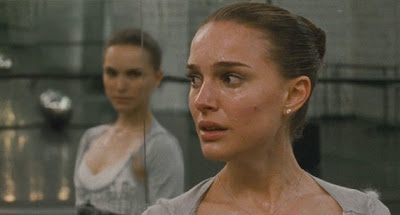
In Black Swan, director Darren Aronofsky (The Wrestler, The Fountain) creates a wonderfully haunting film that truly captures the mindset of a performer. The film follows Nina Sayers (Natalie Portman), a young ballerina, as she lands the lead in her company’s production of “Swan Lake.” Upon accepting the role, she begins to feel enormous pressure from not only the company’s pretentious director (Vincent Cassel), but also her mother (Barbara Hershey), a former ballerina who retired upon becoming pregnant with Nina. Wracked by the mounting pressure, Nina mentally unravels as the show’s opening night draws near.

The film, shot entirely from the perspective of Nina, truly taps into the psychology of its lead character. As Nina loses grip on reality, Aronofsky mirrors her addled state of mind through the film’s visuals. These visuals not only reflect the state of mind of the main character, but also symbolically comment on the plight of an artist. When Nina takes on a role, she feels an intense amount of scrutiny from her director, her mother, and the other actors in the production. To symbolically comment on the idea of being judged, Aronofsky uses mirrors as a visual motif.

The film also hosts an ensemble of great performances. Natalie Portman truly shines as Nina. Emphasizing her character’s naïve shyness and obsessive perfectionism, Portman shows the progression of both her character’s insanity and maturity. By the time the film reaches its last act, Portman completely lets loose and delivers what is perhaps one of the most audacious, confident performances of the year. Barbara Hershey also stands out as Erica, Nina’s oppressive mother. Hershey imbues Erica with an overly protective sweetness, a sweetness entangled with resentment. Mila Kunis, Winona Ryder, and Vincent Cassel all add great detail as the other characters that haunt Nina’s life.

But what truly distinguishes Black Swan as one of the year’s best films is the bold vision of Darren Aronofsky. Creating dozens upon dozens of visual metaphors (some with multiple meanings), Aronofsky layers his film with ideas, symbols, and emotions, all while delivering a superb thriller laced with suspense and atmosphere. Instead of thrilling the audience from the start, Aronofsky slowly builds suspense by luring the audience into a state of unease. While everything feels “normal” in the film’s opening few sequences, Aronofsky adds a few eerie details to convey Nina’s psychological instability. As the film progresses, Aronofsky, conveying Nina’s mental and emotional unraveling, builds upon and exaggerates his style until the film climaxes in a visually stunning, emotionally tense final act.


Aiding Aronofsky’s impeccable atmosphere is Clint Mansell’s score, a haunting take on Tchaikovsky’s Swan Lake mixed with eerie modern overtones. The score, much like the film, grows more intense as the film progresses. The film also boasts some gorgeous camera work from cinematographer Matthew Libatique. In filming the ballet sequences, Libatique captures the feeling of the ballet by moving the camera with the dancers. Not as concerned with the individual ballet moves, Aronofsky and Libatique are more interested in conveying the feeling of ballet than focusing on each precise movement.

While Aronofsky and crew display great talent and ambition, they do not shy away from the film’s genre elements. Intead, Aronofsky fully embraces the idea that he’s making a horror film. While some critics may disapprove of the film’s genre elements, Aronofsky infuses all of the film’s thrills with thematic meaning. With this unique, often exaggerated, visual language, Black Swan truly captures the mind of a performer. Through Nina, the film shows how one can only break free from self-doubt by completely letting go of oneself and creating art. Thus, while the film may come off a tad too ridiculous at times, the fact that Aronofsky is willing to make risky stylistic choices shows that he, like Nina, is willing to let loose to create something truly memorable – an utterly unique and completely mesmerizing work of art.

Friday, November 26, 2010

Never Let Me Hunt Horcruxes for 127 Hours


"Never Let Me Go," based on the novel by Kazuo Ishiguro, follows Kathy, Ruth and Tommy, three schoolchildren, as they mature from their childhood years to early adulthood. The three of them attended the mysterious Hailsham, a secretive private academy for "special" children. As the children grow up, they eventually uncover the secrets of Hailsham, as well as their true identity. The film, directed by Mark Romanek ("One Hour Photo"), is hauntingly beautiful. From the elegant performances from the three young leads (Carey Mulligan, Keira Knightley, and Andrew Garfield) to the stunning cinematography, the film works on both a cerebral and emotional level. The score, by Rachel Portman, adds great poignancy to each scene. But what makes "Never Let Me Go" great is that it insists on asking the big questions. What makes for a memorable life? How does one accept death? Why does time slip away so quickly? While the film does not directly answer any of these questions, it at least makes the audience care for the characters who are struggling with them.


"Harry Potter and the Deathly Hallows Part 1" continues the adventures of the boy wizard as he hunts down Lord Voldemort's Horcruxes (seven fragments of the Dark Lord's soul) in hopes that he can finally finish off the evil wizard for good. While "Hallows" does not rank as high as director David Yates's previous films in the series, "Order of the Phoenix" and "The Half-Blood Prince," it makes for an engaging enough first part to epic finale. Part of what prevents the film truly soaring is its constant reliance on exposition. While the novel by JK Rowling included much of this exposition, it unfortunately did not translate well from page to the screen. By this point, it's almost near impossible for a casual fan of the "Potter" films to comprehend the series's dense plot. Thankfully, the film's acting makes up for some of the script's weaker points. Daniel Radcliffe, Rupert Grint, and Emma Watson give great performances as the now famous trio Harry, Ron, and Hermione. Watson, in particular, lends the film a certain emotional weightiness. But, in the end, this is only Part 1 of a greater film. Hopefully, when Part 2 is released this July, the combined film will make up for some of the flaws of its first part.


"127 Hours," the latest film from director Danny Boyle, stars James Franco as Aron Ralston, a mountain climber with an adventuring, if reckless, personality. While exploring the canyons of Moab, Utah, Ralston gets his hand stuck under a boulder, trapping him in a narrow canyon for - you guessed it - 127 hours. The film, based on a true story, manages to convey the reality of Ralston's situation through Boyle's unique style. Boyle heightens and exaggerates all of Ralston's emotions through several different visual and aural techniques. For example, when Ralston becomes disoriented, the film's visuals become less clear and the film's sound becomes less clear to match Ralston's state of mind. When he is in pain, Boyle uses sharp noises to convey Aron's agony. Boyle's energetic direction, paired with a solid performance from James Franco as Raslton, makes "127 Hours" an engaging, and emotionally uplifting, story. Although the film's ending teeters a bit too far into sentimentality for my liking, Boyle reigns in the emotion well enough to make "127 Hours" one of the best films of the year.

Sunday, October 17, 2010

A "Social" Conversation


I recently had a discussion with my friend Justin about "The Social Network." Ironically, we had the conversation on Facebook! DO HO HO! Since we both brought up some interesting points on the film, I've decided to post the conversation in full on the blog! The following conversation started after Justin commented on the film's hyperbolic tone.

John: I don't think the film's hyperbole is really a problem. The movie makes it very clear that it is not trying to imitate real life. After all, no one really talks in fast-paced, witty, Aaron Sorkin dialogue.

Justin: My comment on hyperbole is in reference to the gross sensationalism, which is good, otherwise the film would be quite boring.

John: I see. I do think the film is trying to say something though. Forgive my pretentious rhetoric, but I see it as a film which puts classic themes (ambition, friendship, betrayal) in a modern context. Before seeing the film, I thought it would be more of a comment on isolation in the digital age, but it's really more about the dangers of ambition and greed.

Justin: True. The majority of the characters have hedonistic tendencies.

John: But that does not mean the film approves of their hedonistic tendencies.

Justin: Definitely not. I think Zuckerberg is the contrast to the hedonism of his environment. He's more "pure." He wants to make something cool and significant, while everyone else wants money and women.

John: I did find it interesting that he did not really care about the money, but, in the end, he screws over his best friend - his only friend. So, I don't really seem him as a "hero." Ultimately, what he did was pretty pathetic. He created a website to impress a girl.

Justin: Right. And I don't think he's a hero because the film does not present an objective morality. For all its hyperbole, everyone is human and prone to error.

John: True. The film doesn't pick sides. While I disagreed with many of Mark's decisions in the film, I could see his point of view, especially when dealing with the Winklevoss twins.


Hey Reader! Do you like this banter? Should I try something like this again? Let me know in the comments! Also, feel free to leave your opinion on the film - to keep the discussion going.

Saturday, October 9, 2010

Grades?

I hate grades. I don't like them anymore. My opinions always change and I feel like written reviews give a better idea of how much I like a film.

From now on, I am going to just list all the films of the year in descending order - from most favorite to least favorite.

P.S. I will try to write a full review sometime soon.

Friday, October 1, 2010

The Social Town

So, I haven't made a post in over a month! YIKES! I've been busy and will probably remain busy through the rest of the year. I'll try my best to give some updates on what I've seen.

For now, how about a few a bullet point reviews?

"The Town"
  • Lackluster script
  • Two-dimensional characters
  • Strong directing and acting, but fails due to its aforementioned weakness (not to mention the totally cheesy ending).
  • C+

"The Social Network"
  • Pointed social critique
  • Shows how ambitions warps one's personal relationships in the modern age
  • Impressive performances from Jesse Eisenberg, Andrew Garfield, and Justin Timberlake
  • Typically strong direction from David Fincher. Snappy dialogue from Aaron Sorkin.
  • Does not quite live up to the hype (but honestly people were comparing it to "Citizen Kane?" How could it live up to that level of hyperbole?)
  • Will probably get better upon repeat viewings
  • B+/A-