Showing posts with label Inglourious Basterds. Show all posts

Monday, January 18, 2010

Oscar Predictions - Box Office vs. Quality


As the 2009 awards season heats up, the Best Picture race seems foggy with a few films fighting it out to claim the big prize. Before this past Sunday’s Golden Globe ceremony, I believed Kathryn Bigelow’s war epic “The Hurt Locker” would nab the Best Picture prize at this year’s Academy Awards. Now, after James Cameron’s “Avatar” clinched both Best Director and Best Picture this past Sunday at the Golden Globes, the category has shifted into a two-horse race, “Avatar” vs. “The Hurt Locker” with Quentin Tarantino’s “Inglourious Basterds” remaining the only possible dark horse.

As for Jason Reitman’s “Up in the Air,” the comedy-drama’s buzz has diminished in the Best Picture category. Unfortunately for Reitman, the film peaked far too early as audience reactions failed to match the enthusiasm of many critics. And while “Up in the Air” received top marks from many critics, it never bested “The Hurt Locker” in terms of critical adulation. While “Up in the Air” won the top prize at the National Board of Review, it failed to clinch the Best Picture/Best Director awards with any other major awards group. The Los Angeles Film Critics, the New York Film Critics, the Broadcast Film Critics Association, and the National Society of Film Critics all awarded “The Hurt Locker” with Best Picture and Kathryn Bigelow with Best Director.

While “The Hurt Locker” has garnered the most critical acclaim, Cameron’s “Avatar” boasts a hefty box office total that could catapult the film to a Best Picture win, not unlike Cameron’s other previous juggernaut, “Titanic.” So, in a sense, the 2009 Best Picture race will pit Box Office against Quality – “Avatar” vs. “The Hurt Locker.” Many will disagree with that last statement. Many will moan that I’m a whiny elitist. But, alas, it is my opinion. While “Avatar” features some great action sequences and whiz-bang visual effects, it simply does not match Kathryn Bigelow’s expert mix of character and action in “The Hurt Locker.”

However, personal opinion aside, Best Picture is shaping up to be an exciting category at this year’s Oscars. Let’s hope the races remains suspenseful until the winner is announced at the Kodak Theater in March.


Friday, January 8, 2010

The Top Ten Best Films of 2009 (Pt. 2 of 2)


1. “Where the Wild Things Are”


Moving, melancholic, and emotionally truthful, “Where the Wild Things Are” is the best film of 2009 and an instant classic. Capturing the highs and lows of childhood, Spike Jonze taps into an unshakable emotional truth that cannot be faked. Every frame of this film is marked with intense feeling and creative passion. Hats off to Jonze and co-screenwriter Dave Eggers for lengthening Maurice Sendak’s original story, while retaining the book’s simplicity. And while the film’s plot is simplistic, the emotions in the movie are complex, messy, and unflinchingly honest. Jonze has undoubtedly created true masterpiece. But, more importantly, he has created a film that means a lot to me. I will forever cherish this wonderful piece of personal filmmaking.


2. “The Hurt Locker”


A phenomenal mix of adrenaline-pumping action and believable, engaging characters, “The Hurt Locker,” Kathryn Bigelow’s Iraq War epic, is a triumphant directorial achievement. Bigelow, who directed cult classic “Point Break,” delivers an unbearably tense and devastatingly realistic picture, depicting the horrors of war without slapping on any explicitly stated political messages. Bigelow, working off a fantastic script by Mark Boal, merely shows the day-to-day life of three bomb tech soldiers. Orchestrating several superb action sequences, Bigelow not only rattles your nerves, but also engages your emotions through her sharp character focus. Bigelow also understands the geography of her sequences. In many supposed “war epics,” the action is so incoherent that the audience has no clue what the heck is going on. This is not the case in “The Hurt Locker.” Bigelow understands the immediacy of her action sequences and perfectly frames them to ensure the audience knows exactly what is going on. Thus, the film drips with intensity. This intense suspense, created by a seamless combination of action and character, makes “The Hurt Locker” proof of Kathryn Bigelow’s immense talent.


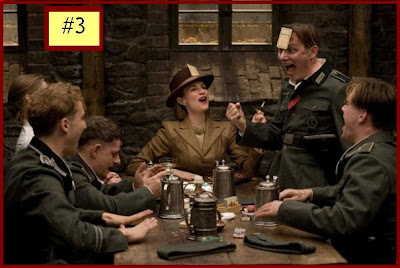
3. “Inglourious Basterds”


Filled with memorable characters and set pieces, Quentin Tarantino’s “Inglourious Basterds,” a film that defies any conventional genre description, works on several different levels. Whether viewed as a Jewish revenge fantasy, or a treatise on the persuasive power of cinema, Quentin Tarantino’s self-proclaimed masterpiece is the most unique film of the year. Boosted by meticulously crafted dialogue and excellent music choices, the film boasts several memorable sequences. From Hans Landa’s interrogation of the French milkman to Shoshanna preparing for her revenge to the tune of David Bowie’s “Cat People,” hardly a scene falls flat. The film also contains several great performances. Christoph Waltz perfectly embodies Hans Landa’s devilish charisma and malicious cleverness. Melanie Laurent captures Shoshanna’s anger and vulnerability with great subtlety. And Diane Kruger amps up Bridget von Hammersmark’s movie star persona, while still capturing the humanity of the character. But, of course, none of these performances would be praise-worthy if Tarantino had not crafted such interesting, layered characters. To conclude, “Inglourious Basterds” stands out as one of 2009’s greatest films from a truly original, insanely gifted, auteur.


4. “Duplicity”


Tony Gilroy’s “Duplicity,” a quick witted spy movie, delights with clever dialogue and suspenseful set pieces. Starring Julia Roberts and Clive Owen as two love-struck corporate spies, the film oozes with charm. While the film’s primary concern is the couple’s spy romance, it also cleverly pokes fun at the competitive nature of the corporate world. In the best opening credits sequence of the year, two corporate CEOs, played with cutting satire by Paul Giamatti and Tom Wilkinson, duke it out at an airplane tarmac. But, this is just one of many great sequences in “Duplicity,” all of which feature a fantastic original score from compose James Newton Howard. Smartly edited and superbly lit, “Duplicity” zips along with comic precision and cinematic pizzazz. Pure filmic fun!


5. “A Serious Man”


An impeccably crafted morality tale, “A Serious Man,” the latest from the great American directors Joel and Ethan Coen (“Fargo,” “No Country for Old Men”), entertains its audience with its deliciously dark humor, while simultaneously confounding them with its deep, often open-ended, themes. However, it is the film’s interpretative thematic queries that make it so fascinating. The film follows Larry Gopnik (Michael Stuhlbarg), a Jewish Physics professor, as his life spins out of control. His wife (Sari Lennick) leaves him for his patronizing colleague (Fred Melaned). His daughter is saving up money for a nose job. An unhappy physics student bribes him for a better grade. And his hillbilly neighbors are encroaching on his property line. All of these problems, ranging from trivial to tragic, make Larry question God’s presence in his life. Seeking answers to his run of bad luck, Larry just wants to know what it all means. By the end of the movie, audiences may be asking themselves the same question. This is not a bad thing. Interpretation and ambiguity, when used correctly, deepens and enriches film. The Coens always challenge their audiences with daring, original work, and “A Serious Man” is no exception.

Sunday, August 23, 2009

"Inglourious Basterds" Review


Sometimes you just have to appreciate a film for its sheer audacity. "Inglourious Basterds," directed by Quentin Tarantion ("Pulp Fiction," "Jackie Brown"), is one of those films. Not only is the film stunningly ambitious and confident, it is also one of the most challenging and unconventional mainstream releases in recent years. For starters, the film is two and a half hours long. And while the film is being marketed as a Nazi-killing action fest, only twenty minutes of the movie contain Nazi-killing action. Instead the film is filled with not one, not two, not three, but several scenes (some of them pushing twenty minutes) of dialogue. And, here's the kicker, most of that dialogue is in a foreign language. Characters speak in English, German, French, and even Italian. You know what that means! Subtitles. Still, this film was released in 3,165 theaters! That is a pretty hefty wide release. Why did the Weinstein Company take such a chance? Why didn't someone tell Tarantino to cut it down? Why didn't they just give it a limited release? Why was the budget 70 million dollars when the film was destined to only make half that much?

Needless to say, I was pretty anxious to gauge the reaction of my audience once the film ended. Would they complain about the subtitles? Bemoan the lack of action? Wonder (like I did) why the studio would release such a weird movie? To my surprise, as soon as the film ended, the theater erupted in instant applause. It did not feel forced. It was not just a few people. It was not a small applause that grew into a big one. It was an instantaneous, unanimous, excited applause. The movie going public had proven me wrong. I sat in my seat ready - almost excited - to hear the dissenting opinions from the non-movie buffs around me. But what I got was even more exciting - an audience embracing a weird, challenging film. I was dumbfounded by the reaction and almost embarrassed by my cynicism. In conclusion, let's just say it was a wake-up call.

Now, enough with this rather lengthy preamble and on with the actual review.

"Inglourious Basterds" follows two revenge plots. One of these plots follows Shosanna Dreyfus (Melanie Laurent), a Jew who is on the run after her family is murdered. The other thread follows Liteunant Aldo Raine (Brad Pitt), the leader of the Basterds - a unit of American soldiers known for their vicious murders of Nazi soldiers. Slipping in and out of both threads is Nazi Colonel Hans Landa (Christoph Waltz), a cunningly evil detective whose nickname is the "Jew Hunter." And, of course, all of these characters and revenge plots collide in one of the best final acts in recent memory.

And it is not just the film's climax that is satisfying. The film's aforementioned lengthy dialogue scenes slowly build suspense from casual conversation to hectic violence. And aiding to this suspense is a trio of great performances. Brad Pitt seems to be having a blast as the Southern blood-thirsty commando and his performance is layered with delicious camp. Melanie Laurent is sympathetic as Shoshanna, while still conveying the character's thirst for revenge. And, finally, Christoph Waltz is outstanding in his performance as Hans Landa. Waltz inhabits Landa's stealthiness with ease and makes it clear that the "Jew Hunter" revels in his own cleverness. Waltz's Hans Landa will undoubtedly join the ranks of Heath Ledger's the Joker (2008's "The Dark Knight") and Javier Bardem's Anton Chigurh (2007's "No Country for Old Men") to complete one of the best string of villains in film history (and I rarely make such hyperbolic statements).

Now, the film is not perfect. It does have a few minor flaws. The Basterd characters seem to conflict tonally with the world that Tarantino has created. While Shoshanna and Hans Landa seem to exist in a slightly altered reality, Lt. Aldo Rane and the Basterds reside in a Looney Tunes cartoon world. When these two worlds first meet, it feels jarring, but as the film progresses into its final act, the mixture becomes more natural as Tarantino solidifies the film's tone. Also, Eli Roth's performance as the "Jew Bear" is almost tortuously bad. The actor/director should stay behind the camera next time.

Despite the unevenness of the Basterd characters, their existence in the film is integral to the film's thematic ideas. The Basterd's vicious murders are presented in a way that is not only fun, but often hilariously kooky. The audience gets their kicks out of seeing the Nazis get their due on the silver screen. Similarly, the film's final set piece takes place in a movie theater where the Nazis get their kicks out of propaganda filmmaker Joseph Goebbels's new film "Nation's Pride." During this scene, the Nazi audience gleefully laughs and applauds as the Germans kill thousands of enemy soldiers on screen. To put it bluntly, the film that the Nazis are watching is not altogether that different than the film Tarantino has made. In fact, one could almost call "Inglourious Basterds" an anti-Nazi propaganda film. But really, the film is about the persuasive, manipulating nature of cinema. Tarantino's kinetic style and fun tone coaxes us into enjoyment. And even the more sympathetic Nazi characters are not treated kindly by the film's supposed heroes. One could even assume Tarantino is asking non-Germans (specifically, Americans) to look at their past and see their own nation’s brutalities (the massacre of the Native Americans, anyone?).

But what Tarantino is mainly commenting on - as mentioned earlier - is the power of film to manipulate its audience. The director is integral to this process. And by excessively name dropping directors in his script, Tarantino is reminding us of this. Thankfully, we do not need a reminder of how great of a filmmaker he is. "Inglourious Basterds," whether viewed as a fun World War II movie or a meta-comment on the nature of filmmaking, is a cinematic delight. In short, it’s glorious.

A-

Top 5 Films of the Year So Far

A few have requested this, so here are my Top Five Films of 2009 (So Far).

5. Star Trek

4. 500 Days of Summer

3. Inglourious Basterds

2. Duplicity

1. The Hurt Locker

Be sure to looks for my "Inglourious Basterds" review, as well as some DVD reviews, later in the week.

What are your top five films of the year (so far)? Did I miss one that you love? Are you appalled at one of my choices? Leave your thoughts in the comments.