
1. “Where the Wild Things Are”
Moving, melancholic, and emotionally truthful, “Where the Wild Things Are” is the best film of 2009 and an instant classic. Capturing the highs and lows of childhood, Spike Jonze taps into an unshakable emotional truth that cannot be faked. Every frame of this film is marked with intense feeling and creative passion. Hats off to Jonze and co-screenwriter Dave Eggers for lengthening Maurice Sendak’s original story, while retaining the book’s simplicity. And while the film’s plot is simplistic, the emotions in the movie are complex, messy, and unflinchingly honest. Jonze has undoubtedly created true masterpiece. But, more importantly, he has created a film that means a lot to me. I will forever cherish this wonderful piece of personal filmmaking.

2. “The Hurt Locker”
A phenomenal mix of adrenaline-pumping action and believable, engaging characters, “The Hurt Locker,” Kathryn Bigelow’s Iraq War epic, is a triumphant directorial achievement. Bigelow, who directed cult classic “Point Break,” delivers an unbearably tense and devastatingly realistic picture, depicting the horrors of war without slapping on any explicitly stated political messages. Bigelow, working off a fantastic script by Mark Boal, merely shows the day-to-day life of three bomb tech soldiers. Orchestrating several superb action sequences, Bigelow not only rattles your nerves, but also engages your emotions through her sharp character focus. Bigelow also understands the geography of her sequences. In many supposed “war epics,” the action is so incoherent that the audience has no clue what the heck is going on. This is not the case in “The Hurt Locker.” Bigelow understands the immediacy of her action sequences and perfectly frames them to ensure the audience knows exactly what is going on. Thus, the film drips with intensity. This intense suspense, created by a seamless combination of action and character, makes “The Hurt Locker” proof of Kathryn Bigelow’s immense talent.
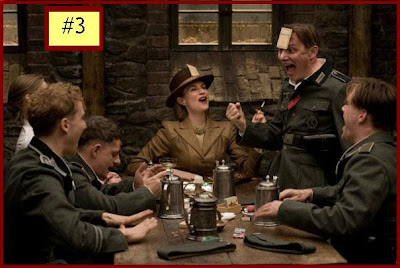
3. “Inglourious Basterds”
Filled with memorable characters and set pieces, Quentin Tarantino’s “Inglourious Basterds,” a film that defies any conventional genre description, works on several different levels. Whether viewed as a Jewish revenge fantasy, or a treatise on the persuasive power of cinema, Quentin Tarantino’s self-proclaimed masterpiece is the most unique film of the year. Boosted by meticulously crafted dialogue and excellent music choices, the film boasts several memorable sequences. From Hans Landa’s interrogation of the French milkman to Shoshanna preparing for her revenge to the tune of David Bowie’s “Cat People,” hardly a scene falls flat. The film also contains several great performances. Christoph Waltz perfectly embodies Hans Landa’s devilish charisma and malicious cleverness. Melanie Laurent captures Shoshanna’s anger and vulnerability with great subtlety. And Diane Kruger amps up Bridget von Hammersmark’s movie star persona, while still capturing the humanity of the character. But, of course, none of these performances would be praise-worthy if Tarantino had not crafted such interesting, layered characters. To conclude, “Inglourious Basterds” stands out as one of 2009’s greatest films from a truly original, insanely gifted, auteur.

Tony Gilroy’s “Duplicity,” a quick witted spy movie, delights with clever dialogue and suspenseful set pieces. Starring Julia Roberts and Clive Owen as two love-struck corporate spies, the film oozes with charm. While the film’s primary concern is the couple’s spy romance, it also cleverly pokes fun at the competitive nature of the corporate world. In the best opening credits sequence of the year, two corporate CEOs, played with cutting satire by Paul Giamatti and Tom Wilkinson, duke it out at an airplane tarmac. But, this is just one of many great sequences in “Duplicity,” all of which feature a fantastic original score from compose James Newton Howard. Smartly edited and superbly lit, “Duplicity” zips along with comic precision and cinematic pizzazz. Pure filmic fun!

5. “A Serious Man”
An impeccably crafted morality tale, “A Serious Man,” the latest from the great American directors Joel and Ethan Coen (“Fargo,” “No Country for Old Men”), entertains its audience with its deliciously dark humor, while simultaneously confounding them with its deep, often open-ended, themes. However, it is the film’s interpretative thematic queries that make it so fascinating. The film follows Larry Gopnik (Michael Stuhlbarg), a Jewish Physics professor, as his life spins out of control. His wife (Sari Lennick) leaves him for his patronizing colleague (Fred Melaned). His daughter is saving up money for a nose job. An unhappy physics student bribes him for a better grade. And his hillbilly neighbors are encroaching on his property line. All of these problems, ranging from trivial to tragic, make Larry question God’s presence in his life. Seeking answers to his run of bad luck, Larry just wants to know what it all means. By the end of the movie, audiences may be asking themselves the same question. This is not a bad thing. Interpretation and ambiguity, when used correctly, deepens and enriches film. The Coens always challenge their audiences with daring, original work, and “A Serious Man” is no exception.
 ilmmakers think that suspense is created by constant action, the minds behind “ Duplicity” realize that suspense comes from the stakes of the characters, rather than how many bullets are being fired at them. Accenting the film’s suspenseful, twisty plot is James Newton Howard’s upbeat, jazzy score. Also of note is Robert Elswit’s cinematography which displays the beauty of the film’s various locales. All of these elements combine to make a fun, fluid, and truthful film experience.